#beg/tree
There are three trees:
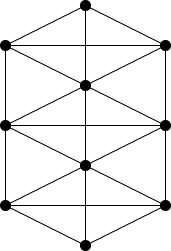
The Tree of Balance, also known as the Primordial Tree, is the tree (template in our modern vernacular) that existed before anything had manifest. It represents that space of Perfection and Balance that was the primordial state from which everything emerged.
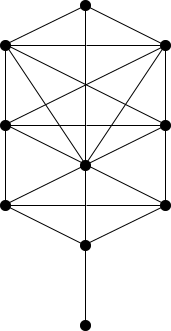
The Tree of Emanation expresses the “emergence” of Malchut, the Kingdom which we inhabit. Following some sources, one could see it as the final step in the unfolding of Malchut out of Keter. Almost like the seed that emerges from the fruit of the Tree, or the butterfly emerging from the cocoon, and in its emergence, reveals its many qualities—sweet, juicy and tender. It is represented by a tree in which Malchut sits at the bottom, below Yesod, hanging, as if by a thread, suspended in endless darkness. It emerges, like a child from the womb of creation
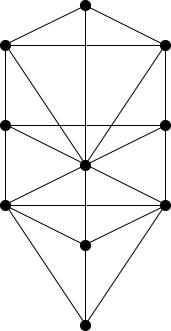
The Tree of Return represents the journey of return to Source. It has the same sephirot arrangement as the Tree of Emanation, but no longer has paths from Chesed and Binah via Da’at—the hidden realm of Knowledge, generally not represented in the Tree—to Chesed and Binah. Instead the paths now appear running from Hod and Netzach to Malchut. Whereas, in the process of emergence, referred to as the “Lightning” bolt, the energy from above, passes through the Veil that separates the material from the spiritual, and descends into the manifest realm. Here, however, we need to reach up to the heavens, by first humbling ourselves.
For a fuller explanation and diagrams, see the “Engine of Emergence”.
Template
The classic modern definition of template is “a gauge, pattern, or mould (such as a thin plate or board) used as a guide to the form of a piece being made” (Mirriam-Webster online). As much as I searched I could not find a more general definition of template, although I found many examples of it being used in the sense that I understand it. That is, as a “design”, an abstract prototype, a wireframe. In programming, it is the definition of a certain structure, that can then be “populated” with actual data to become an “object” which will then make it accessible. It has no existence, except as a well-defined potential space, until it has been populated by individual data that fits into this template. There are functions created to deal reasonably with this data, that is “encapsulated”.
A simple example is a user record. Let us say that we want to capture username and email. We define a template consisting of
	template:
	    user_field: string, 40 characters
	    email_field: string of 30 characters in email format (name@domain)
Next we define the functions that will validate, load, delete, read, modify the data in this field.
At this stage we still have nothing happening. Until we have our first contact, and now we populate these fields with information. Now it exists on the system.
So, one could think of a template as an abstraction of some “pattern” or information that one wants to manipulate, that only has “meaning” once it is being “used”. Perhaps one could think of a mathematical equation that way too.
The fourteen-word sentence
Either zero is even or it is not the case that zero is even.
is an instance of the excluded-middle sentence schema for English, which involves the template
Either A or it is not the case that A